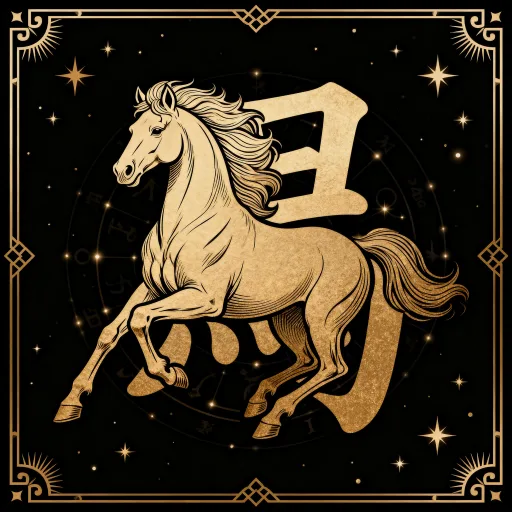
Few symbols in the Chinese zodiac carry the same immediate, visceral charge as this one. The Horse — seventh in the twelve-year cycle, Yang in polarity, Fire as its fixed element — moves through the world at full gallop: restless, luminous, and constitutionally allergic to standing still. Where other signs build their power in stillness or strategy, the Horse generates its force through motion itself.
The Seventh Sign: Order and Orientation
Position matters in the Chinese zodiac. As the seventh sign, the Horse sits at the pivot of the cycle — past the midpoint, pressing into the second half of the wheel with accumulated momentum. In the traditional cosmology of the Twelve Earthly Branches (十二地支, shí èr dì zhī), each sign corresponds not only to a year but to a two-hour window of the day, a compass direction, and a season. The Horse governs the midday hours, the zenith of the sun — the moment of maximum light, maximum heat, maximum exposure. There is nothing hidden about this energy. It announces itself.
Yang Fire: The Signature Energy
Yang is the active, outward-facing pole of the yin-yang duality — expansive, solar, initiating. Paired with Fire as its fixed element, the Horse carries a double charge of heat and forward drive. In the Five Agents (五行, wǔ xíng) — Wood, Fire, Earth, Metal, Water — Fire governs passion, clarity, transformation, and the will to illuminate. A fixed elemental assignment means this quality is intrinsic, structural, not borrowed from the year's annual element: even a Water Horse year or a Metal Horse year carries this irreducible Fire beneath the surface.
This combination produces someone who does not merely participate in life but ignites it. Conversations catch flame. Projects launch with spectacular energy. The room reorganizes itself around the Horse's arrival — not through dominance, exactly, but through sheer radiant momentum.
Core Qualities: Freedom, Energy, Sociability
Three words ground the Horse's character in the tradition: free, energetic, sociable — and each deserves to be read at full depth, not as flattery.
Freedom is not a preference for the Horse; it is a physiological need. Confinement — whether physical, relational, or professional — produces a specific kind of deterioration in this sign: irritability, distraction, a sudden dimming of the characteristic brightness. The Horse does not rebel against structure out of immaturity; it rebels because its nature is genuinely oriented toward open ground. The challenge, and it is a real one, is learning to distinguish necessary freedom from the avoidance of commitment.
Energy here means something more than stamina. It is a quality of presence — the Horse is fully, sometimes overwhelmingly, here, in whatever it is doing. The shadow of this gift is inconsistency: the same intensity that makes the Horse extraordinary in the early stages of any endeavor can make the long middle — the unglamorous, repetitive work of completion — genuinely difficult to sustain. Starts come easily; finishes require conscious effort.
Sociability in the Horse is warm and genuine, not performative. This is a sign that is nourished by human contact, by the exchange of ideas, by the electric friction of different minds. The Horse listens well when engaged and speaks with a directness that others find either refreshing or startling, depending on their own temperament.
Light and Shadow
The Horse's greatest gift and its deepest trap are the same thing: an absolute faith in forward motion.
In its light, this is courage — the willingness to move before certainty arrives, to trust momentum over map. In its shadow, it becomes impulsiveness: decisions made at speed that outpace reflection, relationships entered and exited with a velocity that leaves others disoriented, and a tendency to reframe abandonment as liberation.
The fixed Fire element also carries a shadow of pride. The Horse can be impatient with those who process more slowly, and its directness — so valuable when it lands as honesty — can harden into bluntness that wounds without intending to. The midday energy that is the Horse's birthright has no tolerance for ambiguity or delay, and this can read as arrogance even when the underlying impulse is simply urgency.
Allies and Clash
Within the system of zodiac compatibility — a structured framework of elemental and directional affinities — the Horse's natural allies are the Tiger and the Dog. Together, these three form one of the four great affinity triads of the Chinese zodiac, a grouping whose energies reinforce and harmonize with one another. The Tiger brings bold initiative; the Dog brings loyalty and moral grounding; the Horse brings the kinetic energy that keeps the triad in motion. In relationships — personal or professional — these combinations tend toward mutual trust and a shared orientation toward action and principle.
The Rat stands as the Horse's clash sign — its direct opposite on the zodiac wheel, separated by six positions. In Chinese cosmological thinking, a clash (冲, chōng) is not simply incompatibility; it is a structural tension between two fundamentally different orientations. The Rat is Yin Water — adaptive, strategic, nocturnal, comfortable in complexity and indirection. Where the Horse charges, the Rat maneuvers. Where the Horse needs open sky, the Rat thrives in the intricate passages. This is not a relationship to avoid at all costs, but one that demands conscious navigation: the friction is real, and so is the potential for each to develop what the other naturally lacks.
The Horse in a Chart
In the Four Pillars of Destiny (四柱命理, sì zhù mìng lǐ) — the Chinese system that maps a person's birth year, month, day, and hour onto a grid of Heavenly Stems and Earthly Branches — the Horse may appear in any of the four pillars, and its position shapes how its energy expresses. A Horse in the year pillar colors one's social reputation and ancestral inheritance; in the month pillar, it speaks to career drive and the relationship with parents; in the day pillar, it touches the self and intimate partnerships most directly; in the hour pillar, it describes one's relationship to children, creativity, and the later chapters of life.
Regardless of position, the presence of the Horse in a Four Pillars chart introduces a current of restlessness and vitality that the whole structure must learn to channel rather than suppress.
A Closing Thought
The Horse is not a sign of ease — it is a sign of aliveness. The same Fire that makes it magnetic makes it combustible; the same freedom that makes it inspiring makes it elusive. Working with this energy, rather than simply being carried by it, is the Horse's lifelong practice.
To be born under the Horse is to be given a great deal of wind — the art is learning to sail with it, not merely to run before it.