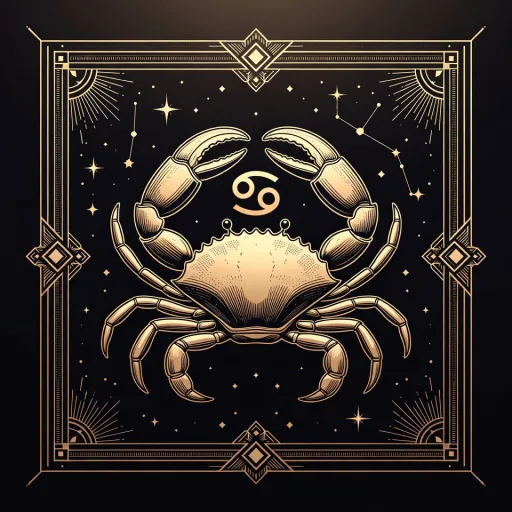
The fourth sign of the zodiac does not announce itself loudly. Cancer moves sideways, like its symbol the Crab — approaching what it wants obliquely, carrying its shelter on its back, feeling the ground before committing weight to it. That image is not weakness; it is a finely tuned survival strategy built around one core imperative: protect what matters.
Spanning roughly June 21 to July 22 in the tropical zodiac, Cancer occupies the 30° sector that opens at the summer solstice in the Northern Hemisphere — the moment the Sun reaches its highest point and then, almost imperceptibly, begins its retreat. There is something fitting in that timing: Cancer is always aware of the turning, always conscious that fullness contains the seed of loss, and that the most loving act is often to hold something safe before it changes.
The Moon, the Element, and the Mode
The Moon rules Cancer, and that single fact explains almost everything. No other planetary ruler is as intimately tied to its sign: the Moon governs tides, cycles, the body's rhythmic memory, the face we show only in private. Through Cancer, lunar energy becomes cardinal — initiating, structuring, building from the inside out. This is cardinal Water: not the still pool of a fixed sign, not the rushing stream of a mutable one, but a spring — the first surge of feeling that sets an entire emotional landscape in motion.
Water as an element carries the symbolic weight of the unconscious, of empathy, of everything that cannot be measured but is nonetheless completely real. In Cancer, Water is personal and ancestral at once. It is the specific smell of a childhood home and the unnamed grief passed down through a family line. Demetra George, writing in the tradition of Hellenistic astrology, emphasizes that Cancer's Water is fundamentally receptive — it takes the shape of its container, which is why environment and belonging are not peripheral concerns for this sign but absolute necessities.
The negative/yin polarity reinforces this receptivity. Cancer draws inward before it moves outward; it processes internally before it responds. This is not passivity — a cardinal sign is never passive — but it is a polarity that values depth of feeling over speed of reaction.
What Cancer Actually Builds
Cancer is often reduced to "nurturing" in popular astrology, which is true but thin. More precisely, Cancer is the sign of constructed safety. It is the architect of the inner world: the person who makes a house into a home, who remembers every anniversary, who knows intuitively what someone needs before they ask. The Moon's rulership means that Cancer operates through attunement — a continuous, largely unconscious reading of the emotional temperature of any room.
This attunement has a creative dimension that is easy to overlook. Dane Rudhyar understood cardinal signs as the initiators of their respective seasonal quadrants, and Cancer initiates the feeling quadrant of the chart. To initiate feeling is to be the one who names what is present in a room, who creates the conditions in which others feel safe enough to be vulnerable. That is a form of leadership — quieter than Aries, less visible than Capricorn, but no less real.
"The Moon does not shine with its own light — it reflects, and in reflecting, it reveals what the Sun alone would never show."
Memory is perhaps Cancer's most distinctive territory. Where other signs live primarily in the present or the future, Cancer inhabits a layered temporality in which the past is never fully past. This can be a profound gift — an ability to honor lineage, to carry forward what is worth preserving, to feel the weight and richness of accumulated experience. It is also, at its most contracted, the thing that keeps Cancer circling old wounds long after the wound itself has closed.
The Shadow
Every sign has a shadow that is simply its gift taken past the point of usefulness, and Cancer's shadow is among the most recognizable in the zodiac. The same attunement that makes Cancer a remarkable emotional intelligence can curdle into moodiness — rapid shifts of feeling that seem opaque to others, tidal swings that the Cancerian themselves may not fully understand. The Moon changes sign every two and a half days; living under its rulership means living with that rhythm in the nervous system.
The protective instinct, when it tightens, becomes possessiveness or withdrawal. The Crab's shell is real: when Cancer feels threatened — or even anticipates threat — it retreats completely, sometimes leaving others bewildered by a sudden coldness that replaced warmth. The indirect approach, so useful as a strategy, can become manipulation when Cancer is unwilling to ask directly for what it needs, preferring instead to create conditions in which others offer it unasked.
The deep attachment to the past can harden into an inability to let go — of people, of grievances, of versions of the self that no longer serve. Liz Greene notes that the Moon's signs tend to confuse emotional security with emotional stasis, and Cancer, more than any other placement, must learn the difference between honoring the past and being imprisoned by it.
Cancer and Capricorn: The Axis of Structure
Every sign is sharpened by its opposite, and Capricorn — Cancer's complementary sign — offers the necessary counterweight. Where Cancer builds inward and personal structures (family, emotional safety, private memory), Capricorn builds outward and public ones (institutions, career, social legacy). Both are cardinal signs, both are builders, but they build in opposite directions along the same axis: the axis of time, continuity, and what we leave behind.
The tension between Cancer and Capricorn is the tension between the home and the world, between the needs of the private self and the demands of public responsibility. In any chart, planets along this axis — whether in the signs themselves or in the 4th and 10th houses that correspond to them — are working out this fundamental question: what do I owe to my roots, and what do I owe to my ambitions?
In Practice: Reading Cancer in a Chart
When the Sun falls in Cancer, the core identity is organized around emotional truth, belonging, and the continuous project of making a self that feels safe from the inside. When the Moon falls in Cancer, it is in its own sign — domicile, in traditional terms — and functions with unusual ease and depth, though the moodiness and impressionability are also heightened.
Cancer rising shapes the entire chart through a lens of emotional receptivity: the body itself may be soft-featured, the first instinct in any situation is to feel before thinking, and the home environment carries enormous psychological weight. Planets placed in Cancer throughout the chart take on its qualities — Mars in Cancer, for instance, acts indirectly and protectively rather than frontally; Saturn in Cancer must work through emotional structures, often experiencing the past as a weight to be consciously examined and set down.
The 4th house, which Cancer naturally governs by correspondence, is the house of roots, ancestry, the private self, and the literal home. Any concentration of planets there — regardless of which sign occupies it in a given chart — echoes Cancerian themes.
Cancer is not the softest sign — it is the most tenacious. What it loves, it does not release easily, and that is both its wound and its gift.