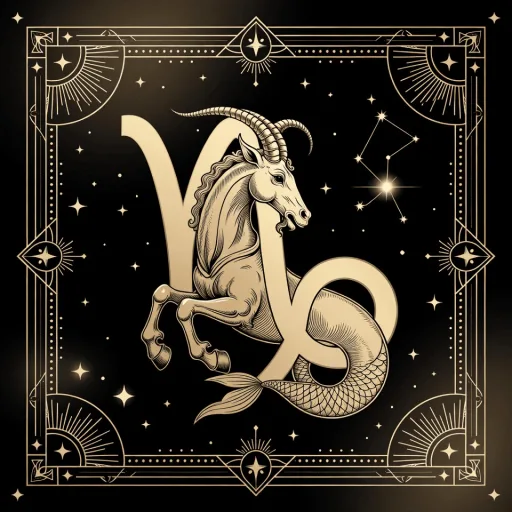
The mountain goat does not leap — it ascends, one deliberate step at a time, finding purchase on rock faces that would send anything less sure-footed plummeting. Capricorn, the tenth sign of the zodiac, carries exactly that quality: a patient, almost geological drive toward the summit. It is the sign that understands, perhaps better than any other, that the most enduring things are built slowly, and that time itself can be an ally rather than an enemy.
The Architecture of the Sign
Element: Earth. Modality: Cardinal. Polarity: yin (negative). This particular combination is worth sitting with. Earth grounds, materializes, and consolidates — it is the element of the tangible world, of results you can hold in your hands. Cardinal energy, however, is initiating energy: the energy of the solstice, of a turning point in the year's cycle. Capricorn begins at the winter solstice (approximately December 22), the longest night in the northern hemisphere — the moment when darkness peaks and the return of light becomes, quietly and inevitably, a promise.
There is something profound in that timing. Capricorn does not initiate with the fire of Aries or the social momentum of Libra (the other cardinal signs). It initiates from within stillness, from the cold and the dark, from conditions that demand austerity. Its cardinal impulse is not a burst — it is a decision, made in silence, to begin the long work.
The yin polarity reinforces this inward quality. Capricorn does not broadcast its ambitions; it pursues them with a concentrated, interior intensity. Where its opposite sign, Cancer, turns that same yin energy toward emotional depth and the nurturing of intimate bonds, Capricorn directs it outward into the world of structure, legacy, and achievement.
Saturn: The Ruling Planet
No planet shapes a sign's character more definitively than its ruler, and Saturn — the Timekeeper, the Lord of Limits — is one of the most exacting rulers in the zodiac. In classical astrology, Saturn was the outermost visible planet, the boundary of the known solar system, and it carried the weight of that position: authority, discipline, consequence, and the irreversible passage of time.
"Saturn does not punish — he simply insists that reality be faced on its own terms." — a principle running through the work of Liz Greene, whose Saturn: A New Look at an Old Devil remains the defining modern study of this archetype.
For Capricorn, Saturn's rulership means that the sign is, at its core, oriented toward mastery through constraint. The limitations Saturn imposes — whether of time, resource, or circumstance — are not obstacles to Capricorn's purpose; they are its very medium. A sculptor needs resistance in the stone. Capricorn needs the resistance of the real world to do its finest work.
Saturn also governs reputation, institutional authority, and the structures society erects to organize itself — hierarchies, laws, professional roles, the long arc of a career. These are Capricorn's natural terrain. The tenth house of the natal chart, traditionally associated with this sign, is precisely the house of public standing and vocation.
Light and Shadow
At its most fully expressed, Capricorn energy is disciplined, reliable, strategically intelligent, and genuinely capable of long-term vision. There is a kind of integrity here that comes from having tested oneself against hard conditions — the Capricorn archetype knows what it is made of because it has asked that question in the cold, without comfort. Demetra George, drawing on Hellenistic sources, notes Saturn's ancient role as the planet of wisdom earned through experience — and that earned quality is exactly what Capricorn at its best embodies. It is the elder who has actually done the work, not merely claimed authority.
The shadow, however, is inseparable from these same qualities. The capacity for long-term planning can calcify into rigidity — an inability to adapt when the plan no longer serves. The drive for achievement can become status-hunger, mistaking the summit for the view. The natural affinity for authority can slide into authoritarianism, or into a cold instrumentalism that treats people as resources rather than ends. And perhaps most characteristically: the Saturnian demand for self-sufficiency can produce a profound difficulty in receiving care, a reluctance to appear vulnerable that quietly isolates.
The opposition to Cancer illuminates this shadow with particular clarity. Cancer represents the home, the mother, the permission to need and to be nurtured. Capricorn, at its most defended, is the figure who has built an impressive life and finds, at its summit, that they have forgotten how to be held. The two signs need each other: Cancer's emotional intelligence softens Capricorn's austerity; Capricorn's structural clarity gives Cancer's feeling-world a form in which to live.
Capricorn in Practice
Within a natal chart, planets placed in Capricorn take on the sign's characteristic gravity and purposefulness. They operate with patience and a certain seriousness — even a natal Venus in Capricorn tends to approach love with the same long-game thinking it would bring to a career, which can read as reserve or even coldness before it reads as loyalty. A Moon in Capricorn is often described, in the tradition running from Ptolemy through Robert Hand, as one of the Moon's more challenging placements: the Moon governs instinct, emotion, and the need for comfort, while Capricorn's Saturnian quality tends to suppress, defer, or structure those needs rather than simply feel them.
The cardinal modality means that Capricorn planets are activated by tension — they respond to challenge, to turning points, to moments that demand a decision. A stellium in Capricorn does not idle; it is always, at some level, assessing the terrain and planning the next move.
Capricorn's natural house — the tenth — governs vocation, public life, and the relationship with authority figures (including, in early life, the parent who represented structure and expectation). Planets transiting Capricorn, or Capricorn on the cusp of any house, bring Saturnian themes into that area of life: the demand to take something seriously, to build something that lasts, to accept responsibility.
The Longer Arc
Capricorn is, ultimately, a sign about the relationship between effort and time. It asks a question that most of us spend our lives negotiating: what are you willing to build, knowing it will take longer than you want, and may only be fully visible to those who come after you? The mountain goat's summit is not always reached within a single lifetime. Sometimes the work is the foundation of something larger — a legacy, an institution, a body of knowledge.
That is not a melancholy prospect in Capricorn's symbolic vocabulary. It is, in fact, the highest expression of the sign: to do the work well enough that it outlasts the doing.
Capricorn teaches that limitation is not the opposite of freedom — it is, when inhabited with full commitment, the very shape freedom takes.