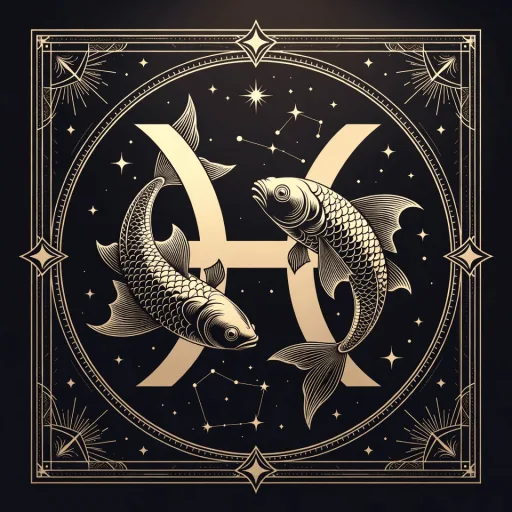
The twelfth and final sign of the zodiac carries the weight of everything that came before it. Pisces — a mutable Water sign spanning approximately February 19 to March 20 — stands at the threshold where the individual self begins to blur into something larger: the collective, the unconscious, the boundless. Its symbol, two fish swimming in opposite directions bound by a cord, captures its essential tension perfectly: the pull toward transcendence and the pull back into embodied life, both real, neither fully winning.
The Core Meaning
Every sign inherits something from its position in the zodiac's sequence. Pisces arrives last, after Aquarius has surveyed humanity from a great intellectual height, and something in this final placement gives Pisces a quality of summation — as if it has already lived through all eleven signs before it and carries their residue. This is why so many astrologers, from Dane Rudhyar onward, have described Pisces as the sign of dissolution: not destruction, but the loosening of fixed boundaries so that what was separate can merge.
As a yin (negative polarity) sign, Pisces receives and absorbs rather than projects and initiates. It is oriented inward and toward others simultaneously — a paradox that defines much of its character. The Water element gives it emotional depth, permeability, and an almost sonar-like sensitivity to the feelings of those around it. Mutable modality adds flexibility and adaptability, but also a certain difficulty with fixity: Pisces energy resists being pinned down, categorized, or confined to a single form.
Rulers: Jupiter and Neptune
Jupiter is the traditional ruler of Pisces, a dignity it shares with Sagittarius. This connection is older than the telescope, rooted in the classical system codified by Ptolemy and elaborated by Vettius Valens: Jupiter governs faith, expansion, mercy, and the search for meaning — qualities that resonate deeply with Pisces's orientation toward the infinite. A Jupiterian Pisces is generous, philosophically inclined, and capable of genuine spiritual largeness.
Neptune, assigned as the modern ruler after its discovery in 1846, has become the dominant lens through which contemporary astrologers read the sign. Neptune governs dreams, illusion, mysticism, and the dissolution of ego boundaries — it refines and intensifies what Jupiter began. Where Jupiter expands through belief, Neptune dissolves through surrender. Liz Greene's work on Neptune remains the most searching psychological treatment of this archetype: she frames it as the longing to return to a state of primordial unity, a longing that can express as spiritual seeking, artistic vision, or, in its shadow, escapism and self-deception.
Both rulers matter. Reading Pisces through Jupiter alone risks missing its oceanic depth; reading it through Neptune alone risks losing its capacity for wisdom, humor, and philosophical joy.
How Pisces Expresses Itself
The Light
At its most integrated, Pisces energy is one of the most genuinely other-directed forces in the zodiac. It feels into situations rather than thinking through them first, and this empathic attunement can make those with strong Pisces placements extraordinarily compassionate companions, healers, artists, and visionaries. The imagination here is not merely decorative — it is a cognitive tool, a way of knowing that bypasses the literal and touches what is real beneath surfaces.
There is also a quality of creative porousness: Pisces absorbs influences, moods, and images the way water absorbs color, and this makes it one of the most naturally artistic signatures in the zodiac. Music, in particular, has a long mythic association with the sign — sound, like water, moves through boundaries rather than around them.
"Pisces does not conquer the world; it seeps into it." — a formulation Howard Sasportas would have recognized in his work on the twelfth house, the domain traditionally associated with this sign.
The Shadow
The same permeability that enables empathy can become a liability. Without a stable sense of self, Pisces energy absorbs not only beauty but also the distress, confusion, and chaos of its environment — and cannot always distinguish between its own feelings and those it has taken on from others. This is the root of what Stephen Arroyo described as the Piscean tendency toward psychic overwhelm: the boundaries are thin by design, but thin boundaries require conscious tending.
The mutable Water combination also produces a characteristic difficulty with commitment to a single direction. Pisces energy is genuinely comfortable holding multiple, contradictory possibilities at once — a strength in creative and spiritual work, a challenge in practical decision-making. The shadow of Neptune is not evil but fog: self-deception, avoidance, the glamour of victimhood, and the seductive comfort of remaining perpetually unformed.
Pisces in the Chart
When Pisces occupies a house in your chart, that area of life tends to operate with less rigid definition — things there may feel fluid, hard to grasp, prone to idealization or confusion, but also open to inspired and intuitive navigation. A planet placed in Pisces takes on the sign's coloring: it becomes more receptive, more imaginative, more attuned to the invisible dimensions of whatever it governs.
The Sun in Pisces places the core identity in a zone of perpetual becoming — a self that is real but resists a fixed outline. The Moon in Pisces is exquisitely sensitive, emotionally absorptive, and nourished by solitude, music, and spiritual practice. Mercury in Pisces thinks in images and metaphors rather than linear logic — a placement that can produce poets and mystics, and that traditional astrology considered a debility (Mercury is in its detriment in Pisces), though modern practice reads it more charitably as a different cognitive register entirely.
The Axis: Pisces and Virgo
Every sign is best understood alongside its opposite, and Virgo is the complementary pole to Pisces. Where Pisces dissolves, Virgo discerns; where Pisces merges, Virgo distinguishes; where Pisces trusts the whole, Virgo attends to the part. Neither is complete without the other. The Pisces–Virgo axis is ultimately about the relationship between wholeness and craft — the vision and the technique, the ocean and the vessel that holds it. Strong Pisces energy, left untempered, can lose itself in the infinite; the Virgoan gift of discrimination and embodied practice is what gives the vision a form it can inhabit.
A Closing Thought
Pisces is not an easy sign to live in a world that rewards sharp edges and clear definitions. But it carries something the other eleven signs cannot fully replicate: the knowledge that the self is not a sealed container, that connection is the deeper reality, and that surrender — chosen, conscious, and courageous — can be its own form of strength.
To be Pisces is to know, in the marrow, that the river and the ocean are the same water — and to spend a lifetime learning when to flow and when to hold a shape.