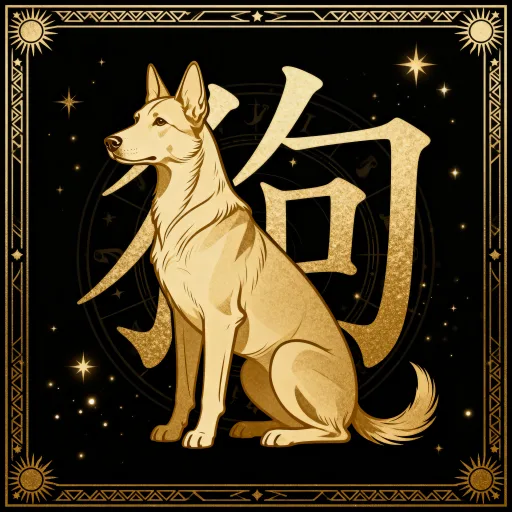
Faithful to the bone, morally alert, and quietly fierce — the Dog occupies the eleventh position in the Chinese zodiac with the gravity of a sign that takes its responsibilities seriously. Where other signs chase ambition or pleasure, the Dog watches the gate, reads the room, and stays.
The Symbolic Core
The Dog is the eleventh of the twelve signs, carrying Yang polarity and a fixed element of Earth. That combination is worth sitting with. Yang gives the Dog its outward orientation — it is not a sign that turns inward and broods; it moves toward others, toward causes, toward the people it has chosen to protect. Earth, as a fixed element, grounds that movement in something durable: values, loyalty, a sense of what is right that does not shift with fashion or convenience.
In the symbolic language of the Chinese tradition, the Dog is the guardian at the threshold — not the warrior who seeks battle, but the sentinel who prevents harm from crossing into the home. Its watchfulness is not paranoia; it is devotion made vigilant.
Light and Shadow
The Dog's greatest strength is also the source of its deepest tension. Loyalty at its finest is one of the rarest human qualities — the Dog offers it freely, almost constitutionally, and expects it in return with the same quiet intensity. Honesty follows naturally: a sign this committed to protecting others cannot afford self-deception or flattery. The Dog tells you the truth, sometimes before you have asked for it.
Protectiveness, the third pillar of this signature, is where the light begins to cast a shadow. Protection that is not examined can curdle into anxiety, suspicion, or a controlling vigilance that smothers the very people it means to shelter. The Dog can become the guardian who never lets anyone leave, the friend whose loyalty tips into possessiveness, the idealist whose moral clarity becomes rigid judgment. Earth, fixed and stabilizing as it is, resists change — and the Dog's shadow is precisely this: a difficulty accepting that the world, and the people in it, will not always hold still.
The Dog does not fear danger; it fears betrayal. That distinction shapes everything about how this sign loves and how it suffers.
There is also a thread of pessimism woven through this archetype. Because the Dog is so attuned to what could go wrong — to threats, to disloyalty, to the gap between how things are and how they ought to be — it can exhaust itself anticipating harm that never arrives. The vigilance that makes it a magnificent ally can, in quieter seasons, turn inward as worry.
Alliances and Tensions in the Chart
The Chinese zodiac organizes its twelve signs into a web of affinities and frictions, and the Dog's position within that web is telling.
Its allies are the Tiger and the Horse — a trio that shares an orientation toward action, principle, and a certain noble restlessness. The Tiger brings courage and authority; the Horse brings freedom and momentum; the Dog brings steadfastness and moral compass. Together they form what the tradition calls a san he, a harmonious triangle, each sign amplifying what the others need. Where the Tiger charges and the Horse gallops, the Dog holds the ground and keeps faith. In a life shaped by these three energies — whether through birth years, day pillars, or the annual cycle — there is a recurring theme of principled action, of doing what is right even when it costs something.
The clash is with the Dragon — the sixth sign, the most mythically charged figure in the entire zodiac. This opposition is not merely a personality mismatch; it is a structural tension between two very different ways of inhabiting the world. The Dragon commands through charisma, vision, and an almost imperial self-belief. The Dog commands through integrity, constancy, and earned trust. The Dragon looks toward the horizon; the Dog watches the door. Where the Dragon sees the Dog's caution as limitation, the Dog sees the Dragon's grandeur as untethered from real accountability. When these two energies meet in a chart — or in a relationship — the friction is productive only if both sides resist the temptation to dismiss the other entirely.
Earth, Fixed and Faithful
The fixed Earth element that belongs to the Dog by nature (distinct from the earthly branch's own elemental associations, which shift by season) reinforces the sign's fundamental character: it builds slowly, holds firmly, and does not abandon what it has committed to. Earth in the Chinese system is the element of center, of transition, of the ground beneath every other movement. It is not the most glamorous element — it lacks Fire's brilliance, Wood's vitality, Metal's precision, Water's depth — but it is the one everything else stands on.
This is the Dog's quiet dignity: it does not need to be the most dazzling presence in the room. It needs to be the most reliable one. And over time, in the long arc of a life or a relationship, reliability becomes its own kind of magnetism.
In Practice
If the Dog year, month, or day appears prominently in a Four Pillars (Bazi) chart, look first at what it is protecting and what it is clashing against. A Dog sitting next to a Dragon in the same pillar or adjacent pillar activates that structural tension directly — it does not mean disaster, but it does mean that the themes of trust, authority, and moral friction will be live wires in the life. A Dog supported by Tiger or Horse energies elsewhere in the chart finds its loyalty channeled and its vigilance given a worthy cause.
The Dog year in the annual cycle tends to bring collective attention to questions of justice, accountability, and the protection of the vulnerable — the sign's themes writ large across public life.
Faithfulness is not passivity. In the Dog's hands, it is the most demanding form of courage — the choice, made daily, to stay.