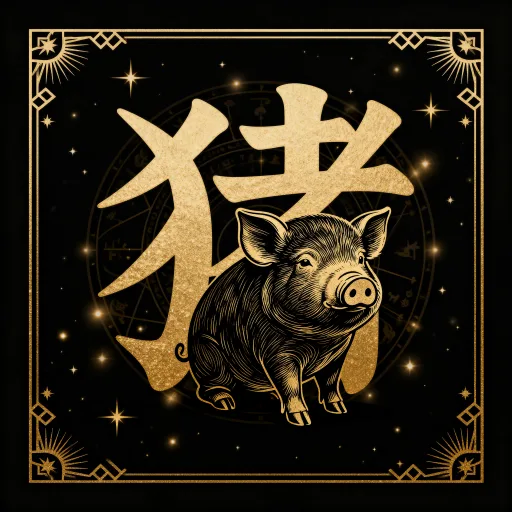
The twelfth and final sign of the Chinese zodiac, the Pig does not end the cycle so much as complete it — carrying within itself the accumulated experience of all eleven signs that came before. Where the Rat opened the wheel with hunger and cunning, the Pig closes it with something rarer: the ability to simply be, without striving, without suspicion, without a hidden agenda.
The Archetype at Its Core
The Pig's essential nature is sincerity. This is not naivety dressed up as a virtue — it is a genuine orientation toward the world that assumes good faith until evidence demands otherwise. Paired with a deep generosity of spirit, the Pig gives freely: time, affection, resources, the benefit of the doubt. There is an ease to this sign, an unhurried quality that can look like laziness from the outside but is better understood as a refusal to manufacture urgency where none exists.
Easygoing is the third pillar of this archetype. The Pig does not bristle at friction; it absorbs it, smooths it, moves on. In a room full of competing egos, the Pig is often the one who quietly keeps the peace — not through diplomacy as strategy, but because conflict genuinely costs them something.
Element and Polarity
The Pig's fixed element is Water — and this is Water in its most yin expression. Where Yang Water crashes and carves (think of the ocean asserting itself against stone), Yin Water seeps, nourishes, and finds the path of least resistance. It is the still lake, the deep well, the underground spring. This elemental signature explains much: the Pig's emotional depth, its capacity for empathy, its tendency to absorb the moods of those around it, and its need — often unspoken — for periods of quiet restoration.
Yin polarity further deepens this picture. Yin signs in the Chinese system are receptive, inward-facing, and relational. They do not initiate so much as respond; they do not conquer so much as cultivate. For the Pig, this means that relationships, comfort, and the texture of daily life carry enormous weight. A Pig thrives when its environment is harmonious and its inner circle is trustworthy.
The Pig asks not "what can I take from this world?" but "what can I offer it?" — and that question, sincerely held, is rarer than it sounds.
The Shadow
No archetype is complete without its shadow, and the Pig's is the direct consequence of its gifts. Sincerity can shade into credulity. Because the Pig does not naturally operate from suspicion, it can be slow to recognize when others do — and this makes it a target for those who mistake openness for weakness. The same generosity that makes the Pig beloved can bleed into self-neglect or financial imprudence, giving beyond what is wise and struggling to say no when the ask comes wrapped in need.
Easygoing, taken too far, becomes avoidance. The Pig's discomfort with conflict can lead it to tolerate situations — relationships, working conditions, personal compromises — long past the point where a more confrontational sign would have acted. There is also a sensual streak in this sign, a love of comfort, pleasure, and indulgence, that can tip into excess when the Pig is unhappy or unstimulated. Water, after all, takes the shape of whatever contains it; without strong boundaries, it spreads.
Alliances and Clash
Within the Chinese zodiac's system of structural relationships, the Pig finds its closest resonance with the Rabbit and the Goat. These three form the San He — the Three Harmonies — of the Water frame, a triangle of signs that share a compatible energetic signature. The Rabbit brings sensitivity and aesthetic refinement; the Goat brings creativity and emotional intelligence. Together, these three signs understand each other instinctively, moving at a similar pace and valuing similar things: beauty, connection, and the avoidance of unnecessary harshness.
The Snake stands in direct opposition — the Liu Chong, or Six Clashes. This is the tension that the Pig's chart must reckon with. Where the Pig is open, the Snake is guarded; where the Pig moves by feeling, the Snake moves by calculation; where the Pig trusts, the Snake tests. This is not a relationship of simple enmity — clashing signs often share a magnetic pull — but it is one that demands awareness. Snake energy can sharpen the Pig's tendency toward credulity; Pig energy can unsettle the Snake's need for control.
In Practice: Reading the Pig in a Chart
In the Four Pillars of Destiny (Bazi), the Pig can appear in any of the four pillars — Year, Month, Day, or Hour — and its meaning shifts accordingly. A Pig in the Year pillar speaks to the generation one belongs to and the family inheritance: a background of generosity, perhaps, or of water-related themes (travel, commerce, emotion). In the Day pillar, which represents the self and the intimate partner, the Pig describes a person who leads with warmth in close relationships and whose deepest need is for a bond built on genuine trust. In the Month pillar, it colors the career and social sphere with the Pig's characteristic ease and people-orientation.
When the Pig's Yin Water interacts with the other elements present in a chart, the dynamics shift. Fire signs (Horse, Snake, Tiger in their Fire aspect) create a productive tension — Water controls Fire in the Wu Xing cycle of the five agents, which can read as either disciplining influence or suppressive pressure, depending on the balance. Wood signs draw out the Pig's nurturing side, since Water feeds Wood. Earth signs can dam the flow, creating a need to watch for stagnation.
The Closing Sign
There is something philosophically significant about the Pig's position as the twelfth sign — the last before the wheel turns and the Rat begins again. In many traditions, the number twelve carries the resonance of completion: twelve months, twelve hours, the full circuit of the sky. The Pig holds that completion not as triumph but as release. It is the sign that knows, perhaps better than any other, how to let things go — a cycle, a grudge, a season of life — and simply move toward what is next with an open hand.
That openness is, finally, the Pig's most enduring gift: not a strategy, not a performance, but a way of meeting the world that makes room for others to be themselves.
The Pig teaches that completion is not an ending but a return — and that the most radical thing a person can offer, in a guarded world, is sincerity without conditions.