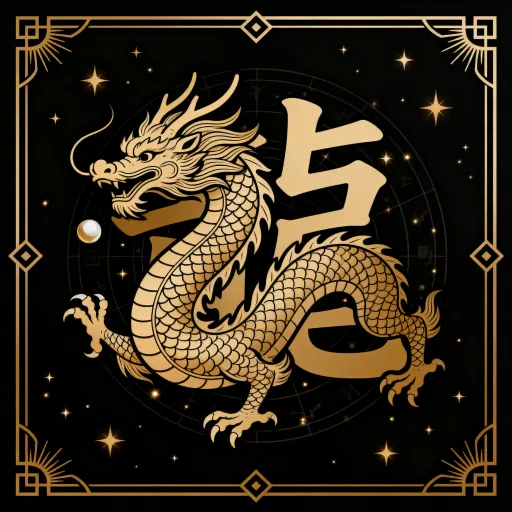
The Dragon is the only creature in the Chinese zodiac that never walked the earth. Every other sign — Rat, Ox, Tiger, Rabbit — is flesh and fur, rooted in the farmyard or the forest. The Dragon belongs to clouds, to imperial thrones, to the place where heaven and earth negotiate. That mythic singularity is not decoration: it tells you something essential about how this sign operates in a human life.
The Fifth Position and What It Means
Order matters in the twelve-sign cycle. The Dragon holds the fifth place — past the cautious opening moves of Rat, Ox, Tiger, and Rabbit, and right at the moment when the cycle finds its confidence. Five is neither beginning nor middle; it is the pivot where energy tips from gathering to expressing. The Dragon arrives already charged, already convinced of its own necessity. That conviction is not arrogance in the pejorative sense — it is structural. The sign is built around the assumption that its presence makes a difference, and more often than not, the world confirms that assumption.
Yang, Earth, and the Paradox of the Dragon's Element
The Dragon carries Yang polarity, which in the Yīn-Yáng framework means active, outward, initiating — the force that moves toward the world rather than receiving it. This aligns perfectly with the Dragon's instinct to lead, to project, to occupy the center of any room it enters.
Its fixed element is Earth, and here lies the sign's most productive tension. Earth in the Chinese elemental system — one of the five agents (wǔ xíng: Wood, Fire, Earth, Metal, Water) — governs stability, groundedness, accumulation, and the capacity to hold and consolidate what has been built. Set against the Dragon's soaring, mythic Yang energy, Earth acts as ballast. The Dragon does not simply ignite and burn out; it builds. Its ambitions are not fantasies — they are projects, legacies, structures meant to last. The Yang fire of personality is always in conversation with an Earth-rooted need to make things real and durable.
Core Character: Light and Shadow
Charisma, ambition, and luck are the three pillars of the Dragon's reputation, and each deserves an honest look at both its gift and its cost.
Charisma here is not merely charm — it is a gravitational field. People orient toward the Dragon without quite knowing why. This makes the Dragon a natural leader, a compelling presence in any collective endeavor. The shadow is isolation: when everyone expects you to be extraordinary, ordinary human need becomes difficult to express. The Dragon can find itself performing magnetism long after it would rather simply rest.
Ambition in the Dragon is not the anxious, scarcity-driven hunger that drives some signs. It is closer to a sense of vocation — the Dragon genuinely believes it is here to do something significant, and it pursues that belief with remarkable stamina. The shadow is inflexibility. The Dragon's certainty about its own vision can make it dismissive of counsel, resistant to collaboration, and genuinely bewildered when the world fails to cooperate. Pride, in the classical sense — hubris — is the Dragon's oldest wound.
Luck is the most mythologically loaded of the three. In Chinese cosmology, the Dragon is the bringer of rain, the guardian of imperial authority, the creature closest to heaven's favor. Luck, for the Dragon, is less about random fortune than about a certain alignment between the sign's natural force and the currents of the world. Things tend to open for the Dragon — doors, opportunities, conversations — in ways that feel uncanny to observers. The danger is dependency: a Dragon who mistakes structural luck for personal invincibility stops doing the Earth-element work of consolidation and finds that even the most charmed life has its reversals.
The Dragon in Practice: Allies and Clash
The Chinese zodiac organizes its twelve signs into relational triangles and direct oppositions that describe the energetic affinities and frictions between signs.
The Dragon's allies are the Rat and the Monkey. These three form one of the four great sān hé (三合) triangles — the combination of signs whose energies reinforce and complete each other. The Rat brings strategic intelligence and adaptability; the Monkey brings wit, ingenuity, and the ability to improvise under pressure. Together with the Dragon's force and vision, this triangle covers the full arc from conception to execution. In any collaborative context — professional, creative, familial — Dragon, Rat, and Monkey tend to bring out each other's best.
The clash is with the Dog. In the twelve-sign wheel, the Dog sits directly opposite the Dragon, and the liù chōng (六冲) — the six clashes — describe pairs whose fundamental orientations create friction. The Dog is loyal, principled, and deeply concerned with justice and community; it is also skeptical of grandeur and instinctively suspicious of anyone who seems too certain of their own greatness. The Dragon's imperial self-assurance meets the Dog's moral scrutiny, and neither yields easily. This does not make Dragon-Dog relationships impossible — tension, honestly inhabited, is one of the most productive forces in any chart or relationship — but it asks both parties to do real work.
Reading the Dragon in a Full Four Pillars Chart
In Bāzì (八字) — the Four Pillars of Destiny system, which reads the Year, Month, Day, and Hour of birth, each carrying a Heavenly Stem and an Earthly Branch — the Dragon can appear in any of the four pillars, and its position shifts its meaning considerably. A Dragon in the Year Pillar speaks to ancestral inheritance and public reputation; in the Month Pillar, to career drive and the social self; in the Day Pillar, to the core identity and intimate relationships; in the Hour Pillar, to inner life, later years, and the legacy one consciously builds.
The Dragon's Earth element will interact with the other elements present in the chart — strengthening Metal (Earth produces Metal in the shēng cycle), potentially overwhelming Water, and being shaped in turn by Fire (Fire produces Earth). No sign reads in isolation; the Dragon's force is always in dialogue with the full configuration of the birth moment.
The Dragon does not ask permission to take up space — but the wisest Dragons learn that space, once claimed, must be tended with the patience of Earth, not just the fire of myth.