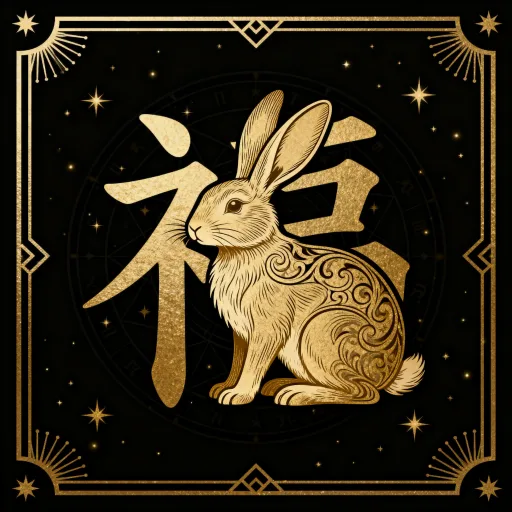
Softness is not weakness — the Rabbit knows this better than any sign in the Chinese zodiac. Where others push, it listens. Where others confront, it negotiates. This is not timidity; it is a particular kind of intelligence, one that reads the room, senses the undercurrents, and moves through the world with an elegance that disarms before it persuades.
The Fourth Sign: Position and Symbolic Weight
The Rabbit occupies the fourth position in the twelve-year cycle of the Chinese zodiac, following the Tiger and preceding the Dragon. In the logic of the cycle, this placement is meaningful: the Tiger's bold, explosive energy breaks open the path, and the Rabbit refines what has been cleared. It is the sign of consolidation after upheaval, of culture after conquest. Ancient Chinese cosmology associated the Rabbit with the Moon — the jade rabbit of lunar mythology is said to pound the elixir of immortality in the Moon's palace — and this lunar kinship deepens the sign's connection to intuition, cycles, and the interior life.
Yin Wood: The Element That Shapes Everything
Every sign in the Chinese zodiac carries both a polarity (Yin or Yang) and a fixed element — a permanent elemental quality that belongs to the sign regardless of the year's ruling element. The Rabbit is Yin in polarity and Wood in fixed element, and this combination is the key to understanding its entire symbolic grammar.
Wood in the five-agent system (wǔxíng) governs growth, flexibility, and the capacity to bend without breaking — think of young bamboo rather than old oak. It is the element of spring, of new beginnings that are still tender, of life pressing upward through the soil. Yin Wood in particular evokes the vine, the climbing plant, the flower: not the straight vertical thrust of Yang Wood (the great tree, the sign of the Tiger), but something more sinuous, more adaptive, finding its way around obstacles rather than through them.
This elemental signature explains why Rabbit natives tend toward the aesthetic and the cultivated. Wood nourishes creativity, and its Yin expression channels that creativity into refinement — in taste, in language, in the careful arrangement of relationships. There is a native appreciation for beauty here that is not superficial vanity but something closer to a philosophical stance: the belief that form and harmony carry meaning.
Core Expression: Grace, Diplomacy, Sensitivity
The Rabbit's most immediately visible quality is its gentleness. It does not announce itself loudly. In social situations it tends to observe before speaking, to listen before judging, to offer a considered word rather than a sharp one. This makes Rabbit natives gifted diplomats, mediators, and counselors — people who can hold tension between opposing parties without being consumed by it.
Refinement runs through everything the Rabbit touches. There is often a preference for quality over quantity, for the well-chosen detail over the sweeping gesture. In conversation, in work, in the domestic sphere, a certain standard is quietly maintained. This is not snobbery — or need not be — but rather the expression of a Wood nature that instinctively tends and cultivates.
Sensitivity, the third pillar of the Rabbit's character, is both its greatest gift and its most demanding challenge. The same perceptiveness that allows the Rabbit to read people with uncanny accuracy also means it registers discord, criticism, and hostility at a pitch others might not even notice. The world, for a Rabbit, is often louder than it appears.
The Shadow: Avoidance, Over-Caution, Detachment
No honest account of a sign omits its difficulties, and the Rabbit's shadow follows directly from its strengths. The diplomatic instinct can slide into conflict avoidance — a reluctance to engage with necessary confrontation that leaves important things unsaid and unresolved. The sensitivity that makes the Rabbit perceptive can become a kind of armor: a polished social surface behind which genuine feelings are carefully concealed.
Over-caution is another recurring theme. Yin Wood's adaptive quality, taken too far, becomes hesitation — an endless reading of the room that delays decision and action. The Rabbit can mistake stillness for safety and find, after a long wait, that the moment has passed. There is also a tendency toward selective detachment: when the emotional environment becomes too turbulent, the Rabbit may simply withdraw, gracefully but completely, leaving others uncertain of where they actually stand.
The Rabbit does not flee the world — it curates its relationship to it. The question is whether that curation serves connection or replaces it.
Allies and Clash: The Rabbit in Relationship
The Chinese zodiac organizes its twelve signs into structural groupings that describe natural affinities and fundamental tensions. The Rabbit's allies — its sānhé, or three-harmony triangle — are the Goat and the Pig. These three signs share an underlying resonance: all three are oriented toward harmony, feeling, and the relational fabric of life. The Goat brings aesthetic sensitivity and emotional depth; the Pig brings warmth, generosity, and an uncomplicated openness. Together, this trio forms one of the zodiac's most naturally cohesive groupings — people who understand instinctively how to make others feel at ease.
The Rooster stands in direct clash (chōng) with the Rabbit — the fourth and tenth signs opposing each other across the cycle. Where the Rabbit is indirect, the Rooster is precise and often blunt. Where the Rabbit values tact, the Rooster values accuracy, even when accuracy stings. This is not simply a personality conflict; in traditional Chinese astrology, a clash between signs indicates a structural friction that can manifest as misunderstanding, competition, or a kind of mutual incomprehension. It does not make relationship impossible — clashes often generate productive tension — but it asks for conscious navigation on both sides.
In Practice: Reading the Rabbit in a Chart
In BaZi (Four Pillars of Destiny), the Rabbit (Mǎo) may appear in any of the four pillars — Year, Month, Day, or Hour — and its position shifts its meaning. A Rabbit in the Year Pillar speaks to the social world, reputation, and early environment. In the Day Pillar, it colors the self and the intimate sphere most directly. The fixed Wood element interacts with the chart's overall elemental balance: a chart already heavy in Wood may feel the Rabbit's qualities amplified to the point of rigidity or over-sensitivity, while a chart dominated by Metal (Wood's controlling agent in the wǔxíng cycle) may experience the Rabbit's expression as constrained or pressured.
The Rabbit year itself — recurring every twelve years — tends to bring a collective atmosphere of negotiation, cultural flourishing, and a preference for resolution over rupture. It is rarely a year of dramatic rupture; it is more often a year in which relationships are renegotiated and the arts thrive.
A Sign That Teaches Through Subtlety
The Rabbit's deepest lesson may be one it offers to those around it as much as to itself: that power does not always announce itself, that influence can travel through a gentle word rather than a raised voice, and that the careful tending of relationships is its own form of mastery. Yin Wood grows slowly, but it finds its way into places that harder materials cannot reach.
To move through the world as the Rabbit does is to understand that grace is not the absence of strength — it is strength made invisible.