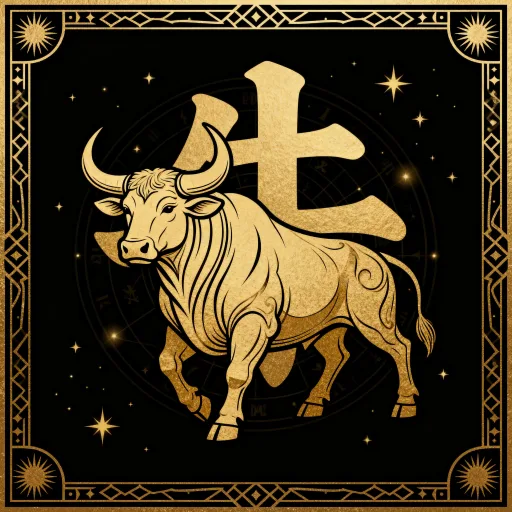
There is nothing flashy about the Ox, and that is precisely the point. Where others sprint, the Ox plows — steadily, methodically, with a certainty that the furrow will be finished by nightfall. As the second sign of the Chinese zodiac, it arrives just after the Rat's quick-witted burst of initiative, grounding the cycle's energy into something durable and real.
The Symbolic Foundation
The Ox carries a layered identity built from three interlocking qualities: its position (second in the twelve-sign cycle), its polarity (Yin), and its elemental nature (fixed Earth). Each layer reinforces the others into a coherent symbolic portrait.
Being Yin means the Ox's power is receptive, inward-turning, and slow to reveal itself. This is not passivity — it is the concentrated force of a root system rather than a flame. Yin energy gathers before it acts; it consolidates before it expands. In the Ox, this translates into a personality that observes long before it speaks, and commits only when it is certain.
Fixed Earth deepens this picture considerably. In the Chinese cosmological framework, Earth (tǔ, 土) is the central agent — the ground beneath all transformation, the axis around which the other four agents (Wood, Fire, Metal, Water) rotate. When Earth is fixed rather than transitional, its stabilizing quality becomes its defining characteristic. The Ox does not merely pass through Earth energy the way a seasonal sign might; it embodies it constitutionally. Reliability, solidity, and a bone-deep resistance to being moved without reason — these are not behaviors the Ox adopts. They are what the Ox is.
Core Expression: The Light
Patience is the Ox's most celebrated virtue, and it is worth understanding what that patience actually looks like in practice. It is not the patience of someone waiting for something better to come along. It is the patience of someone who has already decided what they are building and refuses to be distracted from it. The Ox holds a course through conditions that would scatter more volatile signs — not because it cannot feel the pressure, but because it has assessed the goal and found it worth the cost.
Reliability follows directly from this. When an Ox makes a commitment, the commitment is structural. Others can plan around it the way they plan around a load-bearing wall. This quality makes the Ox an indispensable presence in any collective endeavor — the colleague who delivers, the partner who stays, the friend who appears precisely when they said they would.
Determination completes the triad. Where patience is about time and reliability is about others, determination is about the Ox's relationship with itself. Obstacles are not read as signs to reconsider; they are read as the natural friction of worthwhile work. There is a quiet stubbornness here that the Ox would not call stubbornness at all — simply knowing what one knows.
Fixed Earth does not shift to accommodate the landscape. It becomes the landscape everything else is measured against.
The Shadow: Where Strength Calcifies
Every fixed quality carries its own shadow, and the Ox is no exception. The same determination that makes it formidable can harden into inflexibility — an inability to update a position even when new information genuinely warrants it. The Ox can mistake rigidity for integrity, confusing the refusal to bend with the virtue of constancy.
The deep Yin inwardness, so valuable for concentration and endurance, can also produce emotional reticence that others experience as coldness or distance. The Ox often feels profoundly — but the fixed Earth nature does not easily create channels for that feeling to flow outward. What is rich and warm inside can appear, from the outside, as indifference or self-sufficiency taken too far.
There is also the risk of overwork. The Ox's relationship with effort is so natural that it can forget the body and spirit have limits. The furrow gets finished — but at what cost to the one holding the plow?
Alliances and Tensions in the Cycle
The Chinese zodiac organizes its twelve signs into structural relationships — triangles of affinity and axes of clash — that describe where a sign finds its natural resonance and where it meets its most productive friction.
The Ox's allies are the Snake and the Rooster. These three form one of the four great affinity triangles of the zodiac, bound together by a shared orientation toward focus, precision, and the long view. The Snake brings strategic depth and intuitive intelligence; the Rooster brings discernment, order, and an exacting eye for quality. Together, the three form a coalition that is almost impossible to outmaneuver over time — not because they are aggressive, but because they are thorough. What this triangle builds, it builds to last.
The Goat stands in direct clash with the Ox — the axis of opposition that generates the cycle's most pointed tension. Where the Ox is fixed, structured, and self-sufficient, the Goat is fluid, aesthetic, and deeply oriented toward harmony and interdependence. These two signs are not enemies in any simple sense; their clash is more like the productive tension between form and feeling, between the skeleton and the breath. In a chart or a relationship, this axis asks both parties to develop what the other already holds naturally.
The Ox in Practice
If the Ox appears prominently in your Four Pillars chart — whether in the year, month, day, or hour pillar — its fixed Earth energy colors that layer of your life with a particular quality of endurance and consolidation. A Day Master Ox suggests someone whose core identity is built around steadiness and productive effort; a Year Pillar Ox speaks to a generational cohort shaped by collective themes of rebuilding and patient accumulation.
The Ox years themselves tend to carry this signature into collective experience: periods that reward sustained effort over speculation, that favor those willing to do the unglamorous foundational work. They are rarely dramatic years, but they are years in which real things get built.
It is worth noting that the fixed Earth of the Ox is not inert. Earth, in Chinese cosmological thought, is the mediator between Heaven and the human world — the ground through which all nourishment passes. The Ox's stability is not stagnation; it is the precondition for everything else to grow.
A Closing Thought
The Ox asks a question that most of us find quietly difficult: Can you remain faithful to what matters, long after the excitement of beginning has worn away? That question is its gift and its challenge — to the Ox itself, and to everyone who relies on one.
The Ox does not move mountains. It moves the earth, one deliberate furrow at a time, until the mountain is simply no longer in the way.