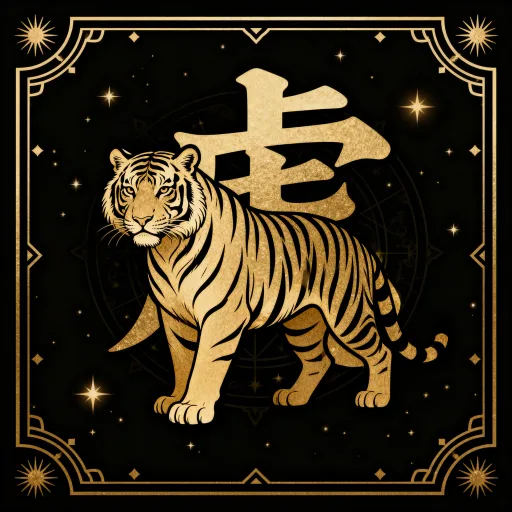
Fearless, magnetic, and impossible to ignore — the Tiger does not enter a room so much as claim it. Third in the wheel of the Chinese zodiac, this sign carries a Yang charge so concentrated that it tends to polarize everyone around it: people are drawn in or instinctively step back, rarely indifferent. That intensity is not performance. It is the natural gravity of a creature whose symbolic essence is fixed Wood — living, upward-driving force that does not bend easily and does not apologize for growing toward the light.
The Architecture of the Sign
The Chinese zodiac organizes its twelve animals across a framework of three interlocking axes: polarity (Yin or Yang), element (one of the five agents — Wood, Fire, Earth, Metal, Water), and modality (each element appearing in both a fixed and a transforming mode). The Tiger sits at the intersection of Yang polarity and fixed Wood, which shapes everything about how its energy moves.
Wood as an agent corresponds to springtime, to upward momentum, to the capacity to break through resistance the way a root splits stone. In its fixed expression, this is not the tender shoot of early growth but the established trunk — firm, directional, already committed to its own axis. Yang amplifies the outward thrust of that Wood nature: the Tiger's energy radiates outward, toward action, toward challenge, toward the world. It does not wait to be invited.
Core Expression: Light and Shadow
At its best, the Tiger embodies a bravery that is genuinely rare — not the absence of fear, but the refusal to let fear make decisions. There is a quality of moral courage here that goes beyond physical boldness: the Tiger tends to act on principle even when the cost is high, to name what others leave unspoken, to move when others calculate. Paired with that courage is an almost feline intensity of focus. When the Tiger commits — to a person, a cause, a creative project — the commitment is total.
The shadow of the same configuration is equally vivid. Rebelliousness, the third defining trait of this sign, is a gift when it dismantles structures that deserve dismantling. It becomes a liability when it operates on reflex — when the Tiger resists authority not because that authority is wrong but simply because being told what to do triggers something ancient and bristling. Fixed Wood does not yield; that stubbornness, which is a form of integrity under pressure, can curdle into inflexibility when the situation actually calls for adaptation. The Tiger can burn through relationships, opportunities, and its own reserves by refusing to distinguish between a battle worth fighting and one that simply presented itself.
Intensity without discernment is fire in a library — the heat is real, but what it illuminates and what it destroys are equally real.
The emotional life of this sign tends to run hotter than it appears on the surface. The Yang face is composed, even commanding — but fixed Wood holds its charge internally, and the Tiger often carries more than it shows. When that internal pressure finds no outlet, it can erupt sideways: through impatience, through sudden withdrawal, through the kind of controlled explosion that surprises everyone who thought the Tiger was fine.
In Practice: How This Energy Moves
In a BaZi (Four Pillars of Destiny) chart — the Chinese astrological system that assigns an animal and element to the year, month, day, and hour of birth — the Tiger's position matters enormously. A Tiger in the year pillar colors the public face and the generational context; in the day pillar, it sits at the core of identity and the way one meets intimate relationship; in the hour pillar, it shapes the inner life and the later years. The fixed Wood charge interacts with every other element present: it feeds Fire, it is nourished by Water, it can be shaped — though not easily — by Metal, and it tends to overwhelm Earth when unchecked.
The Tiger's Yang nature means its energy is most legible in action, in the external world. This is a sign that tends to understand itself through doing — through the feedback of consequence, of resistance, of other people's reactions. Reflection comes, but usually after the move has been made.
Alliances and Tension
The Tiger's natural allies are the Horse and the Dog. These three form one of the four great harmony triads of the Chinese zodiac — a grouping bound by shared elemental affinity and complementary temperament. The Horse brings momentum and freedom; the Dog brings loyalty and moral seriousness. Together with the Tiger's courage, the triad forms a configuration oriented toward action grounded in principle. In a BaZi chart, the simultaneous presence of Tiger, Horse, and Dog in key pillars is considered a significant combination, capable of amplifying Wood and Fire energies considerably.
The Monkey stands in direct clash with the Tiger — the most structurally significant tension in the zodiac. Clash (chong) does not mean simple incompatibility; it means a dynamic of friction, disruption, and forced movement. The Monkey's Metal nature and its quick, adaptive, strategic intelligence sit at a fundamental angle to the Tiger's fixed Wood directness. Where the Tiger commits, the Monkey maneuvers. Where the Tiger leads with courage, the Monkey leads with cunning. In a chart, a Tiger-Monkey clash in active pillars can signal periods of abrupt change, conflict between instinct and strategy, or encounters with figures who operate by entirely different rules. It is not a configuration to fear — but it is one that demands awareness.
What the Tiger Asks
This sign does not offer a quiet life, and it does not pretend to. The invitation it extends — to whoever carries it prominently in their chart, or encounters it in a significant year — is toward full commitment: to act from genuine conviction rather than habit, to lead without needing permission, and to learn, gradually and sometimes painfully, the difference between courage and compulsion.
Fixed Wood grows in one direction. The Tiger's work is to make sure that direction is chosen, not merely inherited.
The Tiger does not ask whether the forest will accommodate it. It grows, and the forest reorganizes itself around that fact.